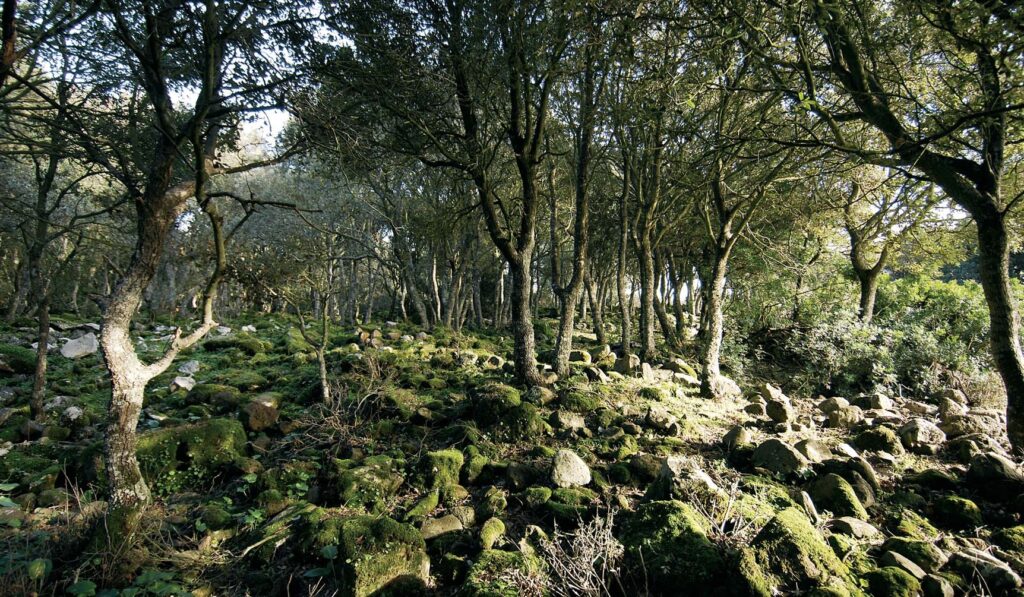
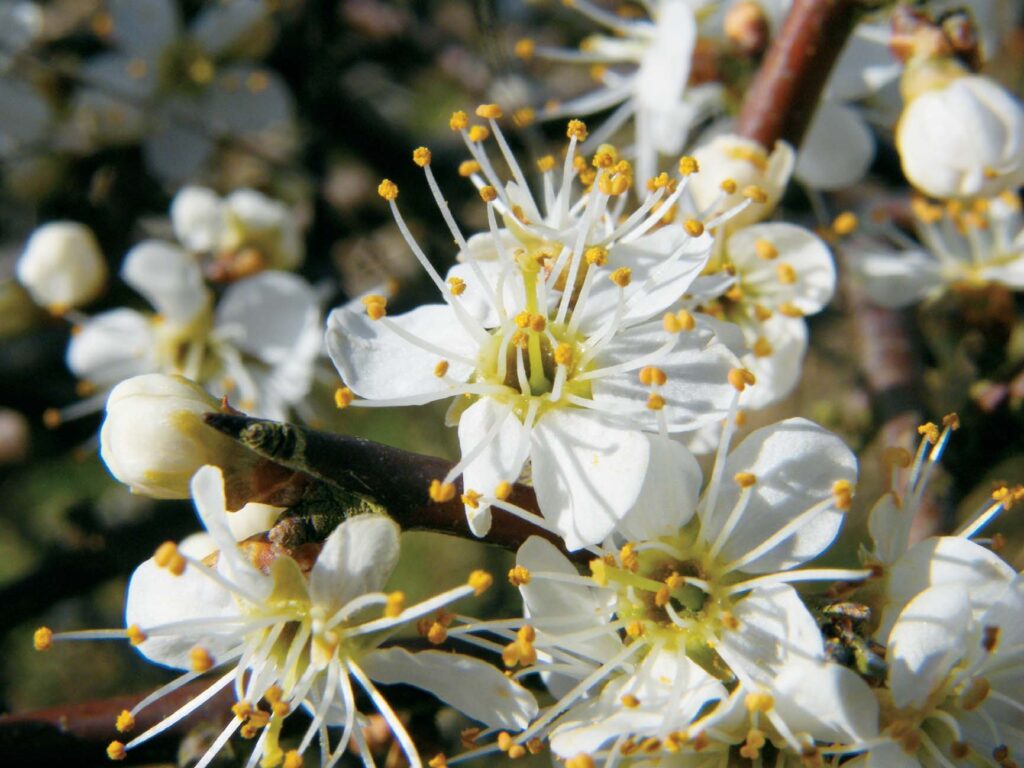
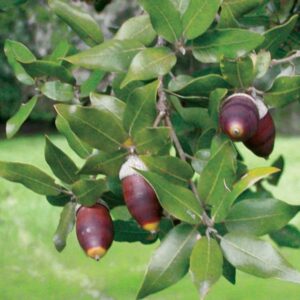
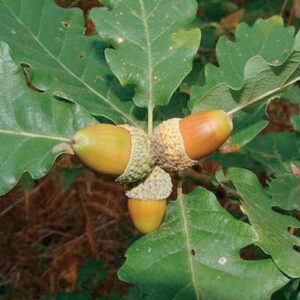
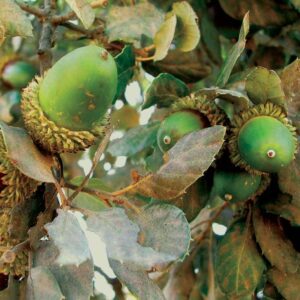
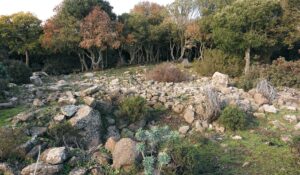
The woodland formations of the Giara are typical of the Mediterranean hilly belt and cover about 46% of the total area of the plateau. Their distribution on the various slopes is determined by environmental factors: on the coldest slopes and in the channels facing the Sarcidano there are woods of overella (Quercus dalechampii Ten.); while on the more temperate slopes oriented towards the Marmilla, dominate the holm oak (Quercus ilex L.) and cork oaks (Quercus suber L.). The forest component has been affected by human interventions, so that today the most widespread wood is cork oak.
In the evergreen forest characterized by holm oak, the dense canopy of trees allows little light to penetrate, so the undergrowth is not very rich. It occupies rocky areas and deep soils.
The fires, grazing and cutting have changed its original appearance, so today we find mainly forests in good condition.
The deciduous mixed forest is characterized by the presence of holm oak and oaks and prefers rocky substrates in wet and cool areas. The oak, during the winter, loses its leaves and in the vegetative phase has racetrees that let out a lot of light: the undergrowth is therefore well developed. On the slopes of Genoni and Gesturi, holm oaks are very rare. It dominates on the slopes of Assolo, Albagiara and Gonnosnò and in the territories of Sini, Setzu and Tuili.
Cork oak is a generally tall, decuscled formation created by man who has removed the shrub layer to promote the growth of herbaceous plants, more suitable for feeding livestock. In the woods left to develop naturally, on the other hand, the cork oak, accompanied by holm oak and oaks, has a rich and well-developed undergrowth.